
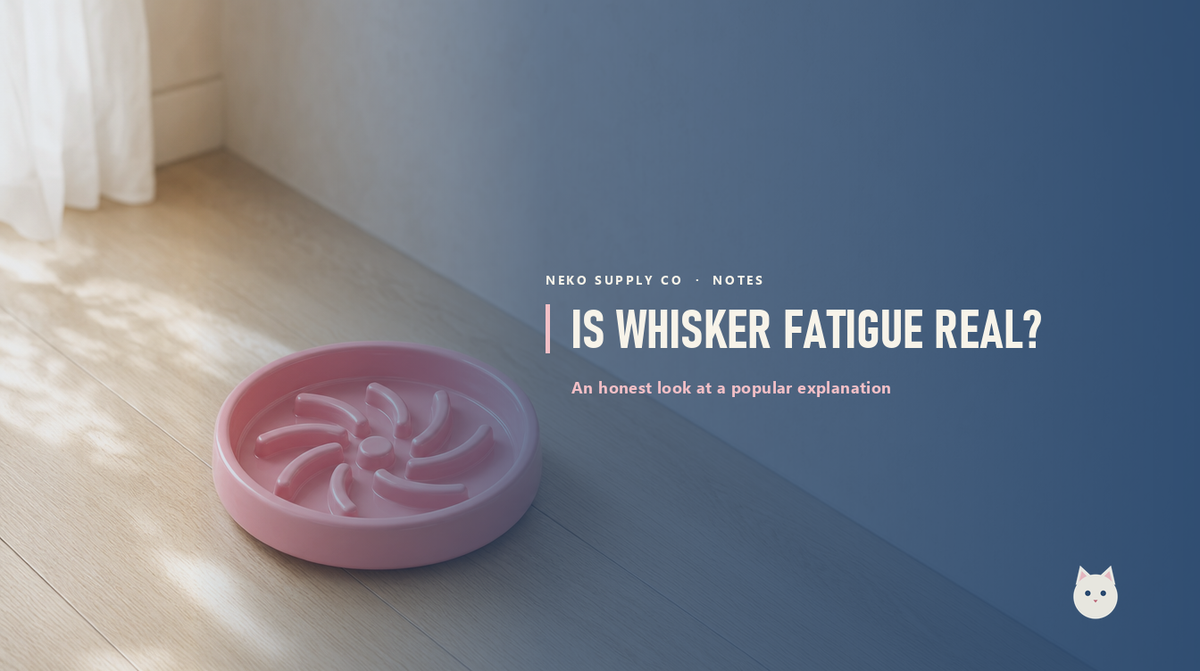
Whisker fatigue is a widely repeated idea with very little research behind it. Whiskers are genuinely sensitive, and some cats clearly dislike eating from deep narrow bowls, but the specific claim that whisker contact causes a distinct exhaustion syndrome is not well established. We sell a wide bowl and we still would not tell you this is settled science.
What whiskers actually do
Whiskers, properly vibrissae, are not just thick hairs. Each one sits in a follicle packed with nerve endings and blood vessels, and they feed a cat detailed information about air movement, gaps, and nearby surfaces. They are closer to fingertips than to fur. That much is well documented and not in dispute.
The claim
The whisker fatigue argument runs like this: because whiskers are so sensitive, repeatedly brushing them against the sides of a deep bowl overstimulates them, and the cat comes to associate eating with discomfort. The signs usually listed are pacing at the bowl, pawing food onto the floor, eating only from the middle, or walking away from a bowl that still has food in it.
What the evidence supports
Here is the honest position. Whisker sensitivity is real. Cats behaving oddly around deep bowls is real, and most people who live with cats have seen it. What is thin is the step in between: there is very little published research establishing whisker fatigue as a defined condition, and most of what circulates online traces back to the same handful of articles rather than to studies. It is a plausible explanation that has been repeated confidently enough to sound proven.
The competing explanations
- Cats dislike eating in a vulnerable position. A deep bowl restricts their view while their head is down, which is reason enough for a cautious cat to keep looking up.
- Food at the bottom of a deep bowl is harder to reach. Pawing it out may be practical rather than sensory.
- The bowl might be dirty, or in a bad spot. Next to a noisy appliance, or too near the litter tray, will put a cat off more reliably than whisker contact.
- It might not be the bowl. Dental pain, nausea, and a long list of medical causes all produce fussy eating.
So should you buy a wide bowl?
If your cat is pawing food out or eating oddly, a wide shallow bowl is a cheap, harmless thing to try, and plenty of cats do eat more comfortably from one. Just hold the reasoning loosely. You are testing whether your cat prefers a different bowl, which is a sensible experiment, rather than treating a diagnosed condition.
When it is not the bowl
If your cat suddenly stops eating, eats much less, drops weight, drools, or paws at its mouth, please stop troubleshooting bowls and talk to a vet. Dental disease and nausea are common, treatable, and much more likely to be the answer than whisker sensitivity. A bowl is never the right response to a cat that has genuinely gone off its food.
Our version
The Gorogoro Bowl is low and wide at 23 cm across and 5 cm tall, which sidesteps the deep-bowl question entirely, and it has a maze base that slows down a cat who inhales dinner. We have written separately on what a slow feeder does and does not change. ごろごろ gorogoro is the sound a cat makes when things are going well.