
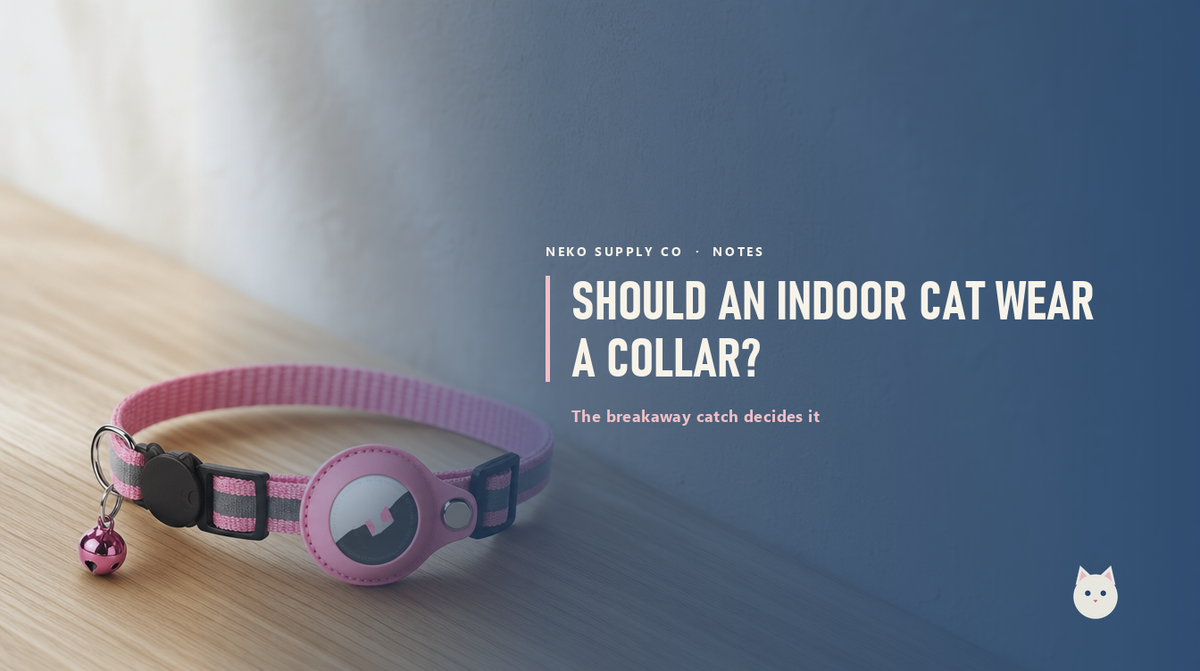
An indoor cat does not need a collar for daily life, but it is one of the fastest ways a lost cat gets home, and indoor cats do get out. If your cat wears one comfortably, keep it on. If your cat is miserable in one, a microchip is the more important thing and you are not failing your cat by skipping the collar.
The case for
Indoor cats escape. Doors get propped open in summer, contractors come and go, window screens give way, and a carrier can fail on the way to the vet. A cat that gets out with no collar looks exactly like a stray, and the person who finds it has no reason to think otherwise. A visible collar with a tag tells a neighbour immediately that this cat belongs somewhere, which often gets it home the same day rather than through a shelter.
The case against
Collars are not free of risk, which is why the catch matters so much. A collar that cannot release can snag on a fence, a branch, a latch, or a heating vent. Some cats also genuinely hate them and will spend weeks trying to remove one, which is stressful for everyone. And a collar is not a tracker, so it does not tell you where your cat is.
The thing that actually decides it
Whether the catch is a breakaway. A cat collar with a proper breakaway releases under sustained pressure, so if it snags, the collar comes off and the cat walks away. That single feature is what turns the risk calculation from questionable to reasonable. If a collar will not release under a firm pull, it is not suitable for a cat, indoors or out. We have written this up properly because it is the most important thing on this page.
Collar or microchip?
Both, and they do different jobs. A microchip is permanent and cannot fall off, but it needs a vet or a shelter with a scanner to read, and it only works if your contact details on the registry are current. A collar is instantly readable by any neighbour, and it can come off. A chip is the backstop and the collar is the fast lane. If you only do one thing today, check that your microchip registration still has your correct phone number on it.
Getting a reluctant cat used to one
- Start with short sessions and something good happening at the same time, like dinner.
- Expect some dramatic flopping and reverse-walking on day one. It passes.
- Check the fit at two fingers, since a collar that is too loose is more irritating and more dangerous than one fitted properly.
- If your cat is still fighting it after a couple of weeks, accept the answer. Some cats simply will not.
What about a tracker?
An AirTag on a collar helps you find a cat that has got out, with real caveats: it is a finder on Apple's network rather than live GPS, so it works well in a street full of iPhones and poorly in an empty field. Worth reading what it does to the safety maths before you add one.
Our version
Every collar in Wear has a breakaway catch, because we would not sell one that did not. The Sakura Collar Set is soft plaid cotton for a cat that mostly stays in, and the Omamori Collar takes your own AirTag if you want the extra reassurance. If you need to size one, here is how to measure.