
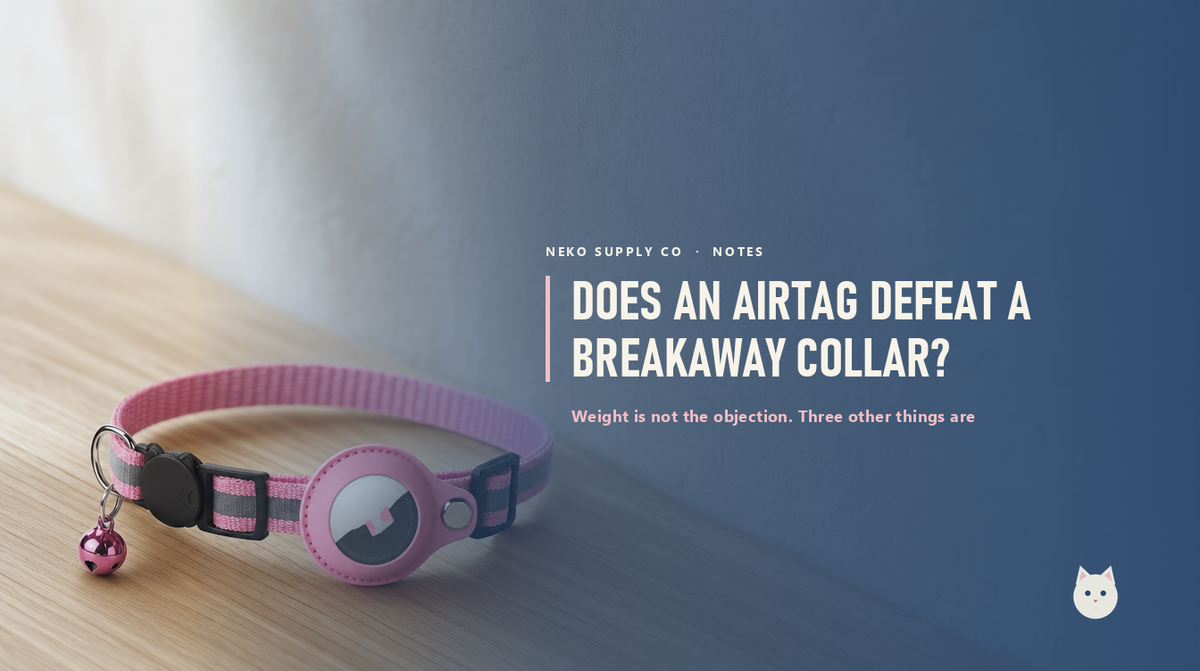
Weight is not the problem, which surprised us when we went looking. An AirTag weighs about 11 to 12 grams, and the cat-specific research on collar-mounted devices puts the ceiling at 2% of body mass, roughly 80 grams for a 4 kg cat. So an AirTag is well inside it. The genuine objections are different: whether the holder interferes with the catch, the fact that it beeps at other people, and that it is not live GPS.
Is an AirTag too heavy for a cat collar?
Almost certainly not, on weight alone.
Apple lists the current AirTag at 0.42 oz (11.8 g), and the original at 0.39 oz (11 g). The figure you will see quoted everywhere is 11 g, which has been out of date since the second generation arrived in January 2026.
The number to weigh it against is not the 5% rule you will find repeated on every pet blog. That rule comes from wildlife radio-telemetry work in the 1960s, not from cat welfare research, and the paper that tested it on actual domestic cats was blunt about its weak footing. Coughlin and van Heezik, in Wildlife Research in 2014, fitted cats with devices at roughly 1%, 2% and 3% of body mass, saw home range and travel distance drop at the heaviest, and concluded that collar-mounted devices on cats should be no more than 2% of body mass.
For a 4 kg cat that is about 80 g. An AirTag plus a silicone holder sits near half a percent. So if someone tells you the weight is the reason not to do this, they have not run the numbers.
So does the holder stop the collar breaking away?
This is the objection that deserves your attention, and we cannot give you a number for it, because no industry standard for breakaway release force appears to exist.
We looked. There is no ASTM, ISO, EN or CPSC standard specifying how hard a cat collar's catch should be to open. Worth knowing if you go looking yourself: two ASTM numbers circulate online as pet collar standards and neither is real. One is the standard for language translation. The other is for toddlers' bicycle helmets. They appear to originate from an AI-written page that other sites then copied.
You will also find release forces quoted as 2 to 3 lb, 3 to 8 lb, 5 lb and various figures in kilograms. They contradict each other, which is itself the evidence: there is no common test method behind them. Even specialist cat collar makers with detailed technical writing publish no figure.
What we can say plainly is the mechanical principle. A breakaway works by releasing at a low, consistent force. Anything that adds bulk near the catch, changes how the strap sits, or lets the collar hang up on something is worth checking rather than assuming. So check yours: hold the collar and pull firmly with two fingers, with the holder and tag fitted exactly as your cat will wear them. If it does not pop open easily, that is your answer, whoever made it.
The part nobody mentions: it beeps at other people
This one catches owners off guard, and it is not a fault. It is the anti-stalking system doing exactly its job.
An AirTag that travels with someone who is not its owner will eventually alert their iPhone with a message reading "AirTag Found Moving With You", and can play a sound. There is a documented case on Apple's own support forum of a dog's AirTag setting off unknown-tracker alerts on the owner's wife's phone and on neighbours' phones when they walked the dog.
Now picture an outdoor cat who does the neighbourhood rounds. The same thing applies.
There is a real fix for part of it: Apple lets you share an item with up to five other people, and shared users do not get tracking alerts. That solves your household. It does not solve the neighbour whose garden your cat treats as a second home. Worth knowing before, rather than after.
It is not live GPS, and in a quiet area that matters
An AirTag has no GPS receiver and no cellular radio. Teardowns confirm what Apple's own spec sheet implies: it is a Bluetooth beacon with an ultra wideband chip for close-range Precision Finding. It has no idea where it is.
What it does is whisper to passing Apple devices, which report the location on its behalf. That means its usefulness depends entirely on how many iPhones walk past your cat. In a dense neighbourhood, updates are frequent. Where few people pass, they are sparse and can be hours apart.
An academic study across 29 countries found location accuracy within an hour ranged from about 80% in places with high iPhone density down to 38% where density was low. We will be straight about the limits of that number: the study was overwhelmingly urban and deliberately excluded rural data, so it does not directly measure life on a country lane. Anyone quoting you a confident rural figure is likely repeating something invented for search traffic.
The honest summary is that an AirTag is very good at answering "which house is she under" and poor at following a cat in motion across empty ground.
Is a collar even safe for a cat?
Reasonable question, and the research is more reassuring than the internet's tone suggests. In a randomised trial of 538 cats over six months, published in JAVMA in 2010 by Lord and colleagues, 72.7% wore their collars for the entire six months, and more than half of the owners said their cats tolerated collars better than expected. Eighteen cats, 3.3%, caught a limb in the collar or caught it on an object or in their mouth.
That 3.3% is not nothing, and it is precisely the reason the catch must release. It is also worth setting against what happens to a cat nobody can identify or find.
What we would actually do
- Use a proper breakaway collar, and test the release with the tag fitted, not empty.
- Two fingers under the strap, checked monthly. That is the fit rule every welfare body agrees on.
- Share the item with everyone in the house so their phones stop alerting.
- Expect a finder, not a tracker. It answers where she was recently seen, not where she is running.
- Leave the battery cover to adults. Coin cells are a genuine ingestion hazard, which is why Apple's cover needs a deliberate press and twist. Apple now suggests a bitterant-coated CR2032, having previously advised against them, so that advice has flipped.

We have written the same caveats on the product page, because they do not stop being true at the point of sale. If you want the wider naming story, an omamori is a real thing and we explain what it actually is.
Sources: Coughlin CE, van Heezik Y. Weighed down by science: do collar-mounted devices affect domestic cat behaviour and movement? Wildlife Research 2014;41(7):606-614. Lord LK, Griffin B, Slater MR, Levy JK. Evaluation of collars and microchips for visual and permanent identification of pet cats. JAVMA 2010;237(4):387-394. Apple technical specifications for AirTag. Jang et al., a measurement study of the Find My network, arXiv:2501.17452.