
An お守り omamori is a small protective charm from a Japanese Shinto shrine or Buddhist temple. It is usually a brocade pouch, a few centimetres across, holding a slip of paper or wood with a prayer or inscription inside. You carry it. You do not open it, and it is not designed to last forever.
What does the word mean?
It comes from the verb 守る mamoru, to protect or to guard, with the polite prefix お. So it is, quite literally, "the protecting thing", said politely.
That politeness is not decorative. An omamori is treated as containing something, rather than being a decorated object, which is why the customs around it are the way they are.
Why are you not supposed to open it?
Because the point of it is inside, and the pouch is a container rather than packaging. The inner slip carries the inscription, and opening the bag is generally understood to undo the thing you acquired it for.
Nobody will chase you down the street. It is closer to a convention than a rule, in the way that a great many customs are. But every source we have read on it agrees, and if you were given one by somebody, the polite thing is to leave it shut.
They come in specific flavours
This is the part that surprises people. An omamori is usually for something, and shrines sell a range:
- 交通安全 kōtsū anzen — traffic safety, the one that hangs from a great many Japanese rear-view mirrors
- 学業成就 gakugyō jōju — academic success, bought in volume before exam season
- 健康 kenkō — health
- 縁結び enmusubi — a good match, the romance one
- 安産 anzan — safe childbirth
Larger shrines have more. There are omamori for business, for warding off misfortune generally, and for passing a driving test.
They expire, and that is deliberate
An omamori is conventionally kept for about a year, then returned to a shrine, where old charms are collected and ritually burned rather than binned. Many people take theirs back around New Year and pick up a fresh one.
We like this part. The object is not treated as a permanent talisman that either works or does not. It is understood to be doing a job for a period of time, after which you thank it and let it go.
Is it religious?
Somewhat, and lightly. Plenty of people who would not describe themselves as religious keep one in a bag or a car, roughly the way plenty of people who are not sailors own a lucky object. It sits in the same broad space as our own mascot, the maneki-neko, which is a folk figure of commerce rather than a devotional one.
If you buy one as a visitor, buying it at the shrine itself is the normal thing, and treating it with a bit of care afterwards is the whole etiquette.
Why we named a collar after one
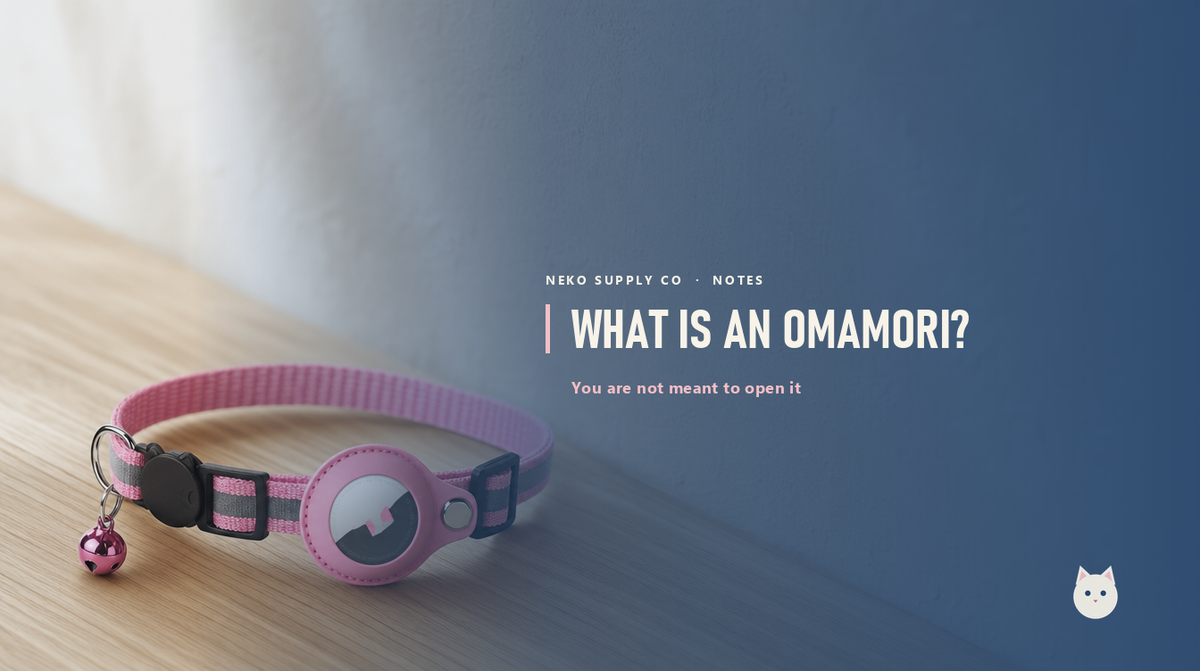
Because the job description matched. An omamori is a small thing that travels with you and is supposed to help you get home. Our Omamori Collar holds an Apple AirTag, which is a small thing that travels with your cat and helps you find each other.
We will not pretend the parallel is profound. A shrine charm carries a prayer and a silicone pocket carries a Bluetooth beacon. But the shape of the idea is the same, and we would rather name a product after something real than invent a word that means nothing.
If you are weighing one up, the honest limitations of putting an AirTag on a cat are here, including the ones most sellers leave out.