
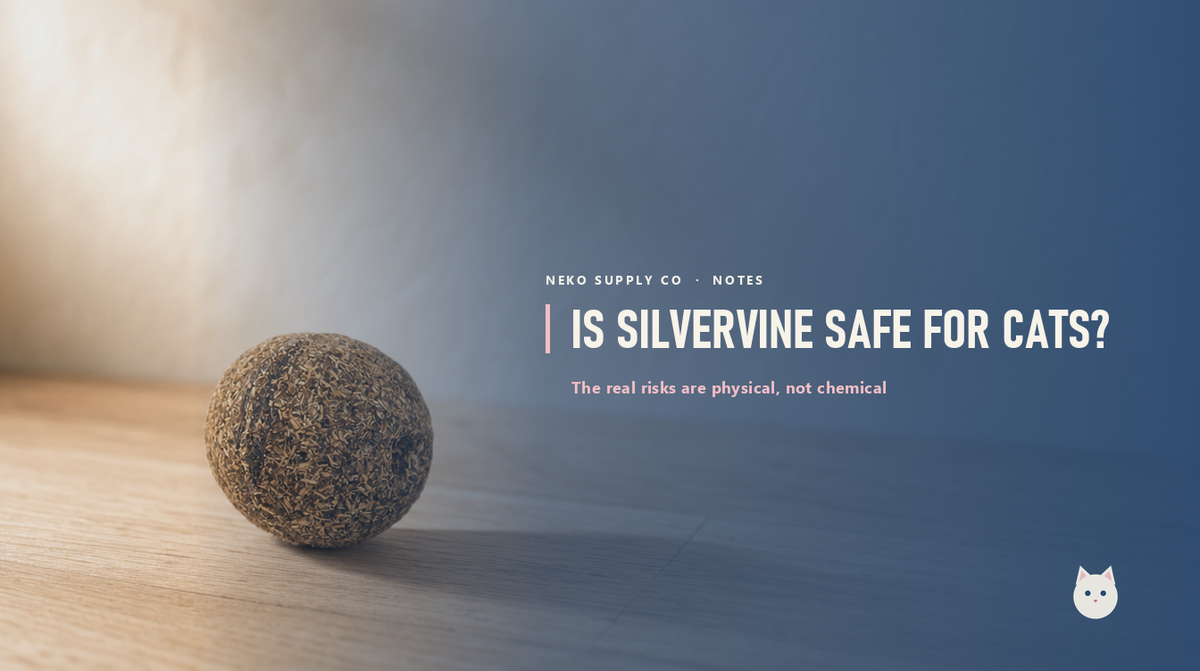
Silvervine is widely regarded as safe for cats, and there is no established toxicity at the amounts a cat encounters through normal play. The genuine risks are physical rather than chemical: chewed-off pieces of stick, small parts, and unsupervised chewing. It is a toy, not a supplement, and it should be treated like one.
What silvervine actually is
Silvervine is Actinidia polygama, a climbing vine from the mountains of Japan and East Asia, related to the kiwifruit. Japanese calls it matatabi. Cats respond to compounds in the plant in much the same way they respond to catnip, with rolling, rubbing, drooling and a few minutes of enthusiasm followed by a nap.
Can a cat have too much?
Cats self-limit. A cat that has had enough walks away, and the usual outcome of a long session is a cat that falls asleep. What overexposure actually does is dull the response: a cat with constant unrestricted access gets less out of it, which is the practical argument for putting silvervine away between sessions rather than a safety one.
If your cat eats a quantity of plant material, you may see some drooling or a loose stool, the same as with any novel plant matter. That is worth a call to your vet if it persists, but it is not a recognised poisoning.
Can cats eat silvervine?
Licking and chewing silvervine is a normal part of how cats respond to it, and nothing suggests that is harmful. Eating it is a different question, and nobody has tested it, so silvervine is not food and should not go in the bowl.
The best safety data we know of is a 2023 study in iScience by Uenoyama and colleagues. Cats were exposed again and again to dried silvervine leaves and extracts. Blood markers of stress (cortisol and glucose) showed no change, liver (ALT) and kidney (creatinine) values stayed within normal ranges for cats, and the response did not meet the definition of dependence.
What that study did not do is feed silvervine to cats. The cats licked and chewed the material, but none of them ate it all up, so the findings describe play, not eating. That is the honest limit of what anyone can say.
In practice: small bits swallowed during play are expected, deliberately feeding it is not something we would do, and the thing actually worth watching is chewed-off pieces, which is the next section.
The risks that are actually worth your attention
- Sticks and chewed fragments. Silvervine sticks are meant to be gnawed, and a determined cat can break off splinters. Those are a choking and gut-blockage risk. Check sticks regularly and bin them once they are chewed down.
- Small parts on toys. Anything silvervine is stuffed inside still has the toy's own hazards: seams, filling, cords.
- Unsupervised chewing. The plant is not the problem. Swallowing a piece of it is.
Notice that none of these are about silvervine being poisonous. They are the same hazards any chewable cat toy carries.
Kittens
Kittens under about six months usually show no response at all, and that is normal rather than a fault in the kitten. The sensitivity develops with age. There is no particular reason to give silvervine to a very young cat, so we would simply wait.
Pregnant cats, and cats on medication
We are not going to guess here. There is not good published evidence either way, and a product page is the wrong place to reason about a pregnant or medicated animal. Ask your vet. That is a genuinely better answer than anything we could write.
What silvervine is not
It is not a calming aid, a supplement, an appetite stimulant, or a treatment for anxiety or any other condition. The research measured behaviour, not health outcomes. We have written up what the studies did and did not show, because the gap between those two things is where most of the marketing lives.
If your cat ignores it
That is common and is usually about the form rather than the cat. Galls work far more reliably than leaf or stick, and the difference is not marginal. There is more on that in why didn't my cat react to silvervine.
One thing we will not do
We are not veterinarians. If your cat is unwell, has eaten something it should not have, or is behaving in a way that worries you, please speak to a vet rather than to a shop. We will happily tell you what a product does and does not do, and that is where our usefulness ends.
Our version
The Matatabi Ball is a pressed ball of natural silvervine, about 3 cm across, with nothing added: no filler, no coating, no glue. We chose a pressed ball rather than sticks partly because there is nothing to splinter off.