
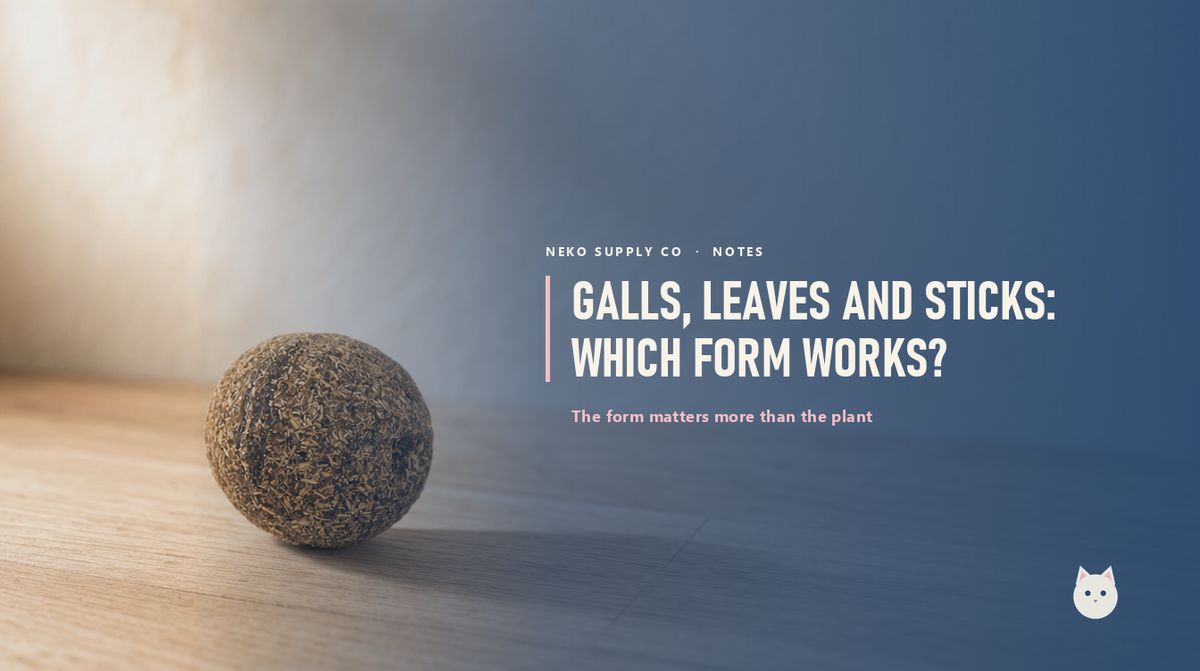
The form matters more than the plant does. In the study most often quoted about silvervine, eight of nine cats responded to dried fruit galls, while ordinary fruit and leaves produced no positive response at all. If a silvervine product did nothing in your house, what it was made from is the first thing to look at.
What is a silvervine gall?
A gall is a fruit that grew the wrong shape. A small insect lays its eggs in the developing fruit, the fruit responds by growing into a lumpy, irregular version of itself, and the chemistry of that lumpy version is not the same as the tidy one next to it on the vine.
It looks like a defect. For this purpose it is the entire point. The galled fruit is the potent material, and the good-looking fruit is not.
How much difference does the form actually make?
A larger difference than most people expect from what is nominally the same plant.
Bol and colleagues, in BMC Veterinary Research in 2017, made their silvervine powder from dried fruit galls. When they then compared materials directly, eight of the nine cats tested responded to the galls, and none responded to ordinary fruit or leaves. The galls also held them far longer, a median of 104 seconds against 13 for ordinary fruit.
So this is not a matter of one form being somewhat better. In that test, one form worked and the other did not register.
What about silvervine sticks?
Here we are going to be straight with you, because this is where most articles start guessing.
Silvervine sticks are cut lengths of the vine, so they are stem material rather than fruit. That study tested galls, ordinary fruit and leaves. It did not separately report on stems. So we cannot honestly tell you that sticks are weak, and we are not going to invent a number for it.
What we can tell you is the shape of the evidence: the potency in that research sat in the galled fruit, and leaf material produced nothing. Stems are closer to leaves than to galls. Draw your own conclusion, but know that it is an inference and not a finding.
So what should I look for?
Ask what is inside it. A product that says only "silvervine" is telling you the species and nothing about the part, and the part is what the research says matters. Fruit gall material is the thing with evidence behind it.
This is also the honest explanation for why two silvervine products can behave completely differently with the same cat, and why a disappointing first try is not proof that your cat is a non-responder.
What we cannot tell you
How long a given product stays potent, for one. We have seen shelf-life advice stated confidently all over the internet with nothing attached to it, and we are not going to add to that pile.
Nor will you find dental, digestive or calming claims here. This is a toy. The measurable thing is what the cat does with it: rubbing, holding it with both front paws, rolling, and then walking away like nothing happened.
The short version
- Galls are the potent form. Eight of nine cats responded to them.
- Ordinary fruit and leaves produced no positive response in the same test.
- Sticks are stem material and were not separately tested. Anyone quoting you a precise stick number is going beyond the evidence.
- If a silvervine product flopped, suspect the material before you suspect the cat.
Our Matatabi Ball is pressed silvervine, and this piece covers the other reasons a cat might walk away from it.
Source: Bol S, Caspers J, Buckingham L, et al. Responsiveness of cats (Felidae) to silver vine (Actinidia polygama), Tatarian honeysuckle (Lonicera tatarica), valerian (Valeriana officinalis) and catnip (Nepeta cataria). BMC Veterinary Research, 2017, 13:70. Open access.