
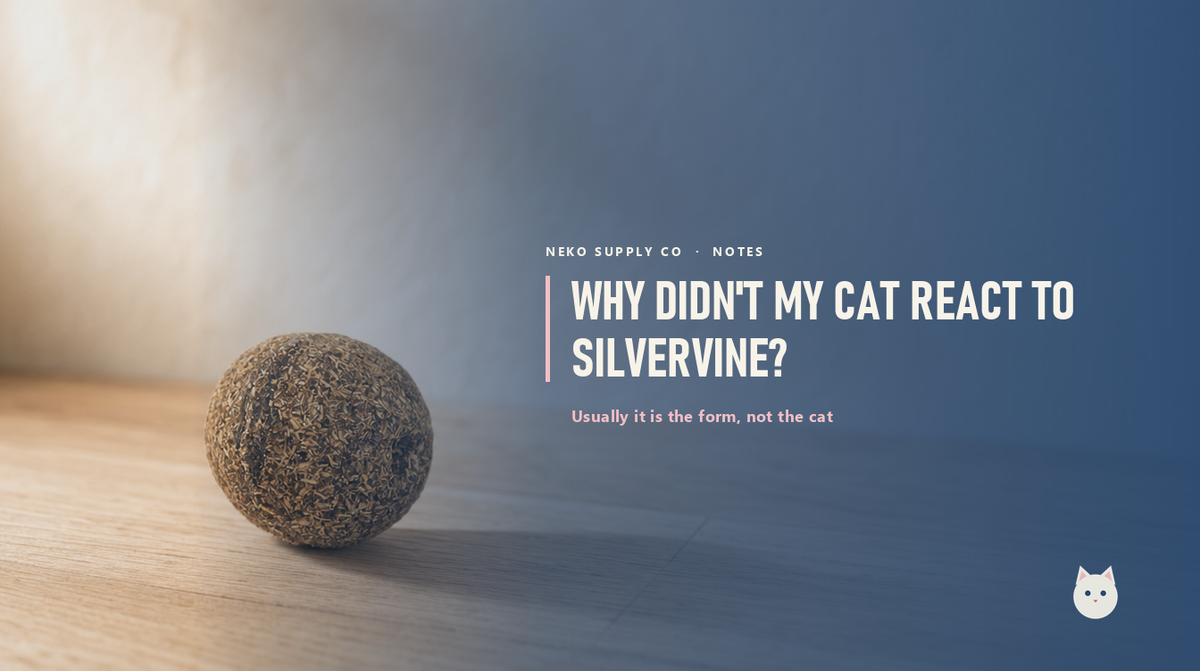
Usually it is the form, not your cat. In the study everyone quotes, cats responded to silvervine fruit galls and ignored ordinary fruit and leaves almost entirely. Age matters less than people assume. And a genuine minority of cats do not respond to any of these plants, which is normal rather than a fault.
How many cats respond to silvervine at all?
In Bol and colleagues, published in BMC Veterinary Research in 2017, 79 of 100 domestic cats responded to silvervine. Across the same group, 68% responded to catnip, 53% to Tatarian honeysuckle and 47% to valerian root.
So silvervine is the most widely answered of the four. It is still not universal. Roughly one cat in five looks at it and walks away, and that cat is fine.
Does the form of silvervine matter?
More than anything else on this page, and it is the part most articles leave out.
The silvervine powder in that study was made from dried fruit galls. A gall is a fruit that grew misshapen after a small insect laid eggs in it, and its chemistry is not the same as ordinary fruit.
When the researchers put the two side by side, eight of nine cats responded to the galls, and none responded to normal fruit or leaves. The reaction to the galls also ran longer: a median of 104 seconds, against 13 seconds for normal fruit.
That single comparison explains most disappointed first tries. Products in this category vary a lot in what is actually inside them, and leaf or stem material is not the same thing as gall. If a silvervine product did nothing for your cat, the honest first question is what it was made from.
Is my cat too young?
Probably not the reason, and we would rather be careful here than repeat the usual line.
The study found no evidence that younger age was associated with increased responsiveness. It did not set out to test very young kittens specifically, so the common advice about kittens under six months is not something that research can confirm or rule out. We mention it because plenty of pages state it as settled fact. It is not.
What if my cat ignores catnip as well?
This is where silvervine earns its reputation. Of the 31 cats that did not respond to catnip, 22 responded to silvervine. That is 71% of the catnip refusers finding something in a plant they had never been offered.
If your cat has stared blankly at every catnip toy you have ever brought home, that is the single best reason to try silvervine instead.
How long should the reaction last?
Shorter than most people expect. The median response to the galled fruit in that study was 104 seconds. Not an afternoon. A minute or two of rubbing, holding, rolling and general nonsense, then a cat who is finished and would like you to know it.
If your cat had a brief burst and then lost interest, nothing failed. That is the normal shape of it.
What we are not going to tell you
You will find pages claiming silvervine cleans a cat's teeth, settles their stomach, or calms an anxious one. We are not going to say any of that. The research does not support it, and the thing in your hand is a toy rather than a treatment.
What we can tell you is what cats actually do with it. They rub their faces on it, grab it with both front paws, roll onto their side, and then get bored and walk off. That is the whole promise, and it is enough.
The short version
- Around 4 in 5 cats respond to silvervine, so a fifth will not.
- Form matters most. Galls produced a response where ordinary fruit and leaves produced none.
- If catnip does nothing for your cat, silvervine is the one to try. It worked for 71% of catnip refusers.
- Expect a minute or two, not an afternoon.
Our Matatabi Ball is a pressed silvervine ball, small enough to be carried off and lost under the sofa. matatabi is simply the Japanese word for silvervine.
Source: Bol S, Caspers J, Buckingham L, et al. Responsiveness of cats (Felidae) to silver vine (Actinidia polygama), Tatarian honeysuckle (Lonicera tatarica), valerian (Valeriana officinalis) and catnip (Nepeta cataria). BMC Veterinary Research, 2017, 13:70. Open access.