
A cat says にゃー nyaa in Japanese, or にゃん nyan for something shorter and cuter. That much is easy. The more interesting part is that Japanese does not stop at noises. It has an entire second category of words for how something seems, which means there are words for a cat's fluffiness, its nuzzling, and the specific way it flops onto its side.
What sound does a cat make in Japanese?
にゃー nyaa is the standard, drawn out the way the cat draws it out. にゃん nyan is the clipped version, and it is the one that ends up in brand names and cartoon dialogue. にゃあにゃあ nyaanyaa is a cat going on about it.
English speakers sometimes assume "nyan" is internet slang because of a certain animated pop-tart. It is not. It is just the ordinary word, the same way "meow" is ordinary in English.
Why does Japanese have so many of these words?
Because it splits them into two jobs, and only one of them exists comfortably in English.
擬音語 giongo are sound words: actual noises, like にゃー. English has plenty of these. Buzz, crash, meow.
擬態語 gitaigo are manner or state words: they describe how something appears, feels or behaves, and they make no sound at all. English is thin here. We have "glitter" and not much else, and we certainly do not have a normal, everyday adverb meaning "in the manner of being pleasantly fluffy".
Japanese does. That is why a language with no particular reputation for sentimentality turns out to have a rich vocabulary for cats specifically.
ゴロゴロ gorogoro: purring, thunder, and doing nothing
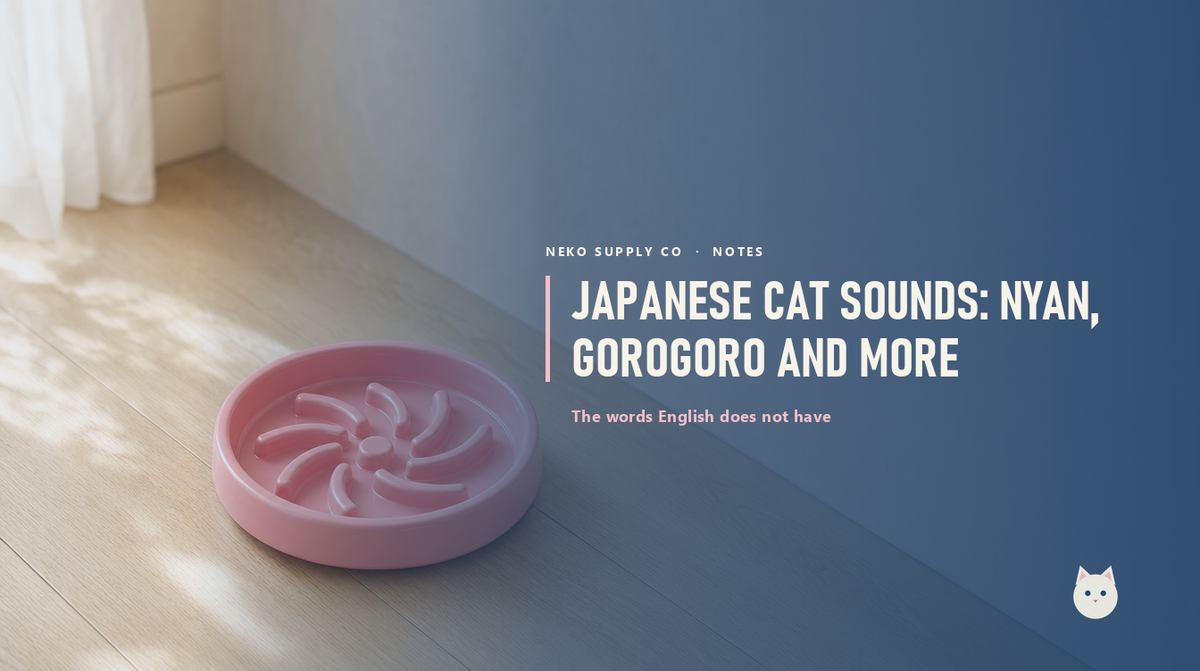
ゴロゴロ gorogoro is the one we named a bowl after, and it is a good example of the range.
It is the sound of a cat purring. It is also thunder rumbling in the distance. It is also a heavy object rolling. And it is also a person lounging around the house all day accomplishing nothing, as in ゴロゴロする, to laze about.
All four are the same idea: a low, continuous, unhurried rumble. A purring cat and a person refusing to leave the sofa on a Sunday are, linguistically, doing the same thing. We find that a more honest description of contentment than anything English offers, which is why it is on the Gorogoro Bowl.
The rest of the useful ones
- ペロペロ peropero — licking. A cat working through a paw, or an ice cream.
- スリスリ surisuri — rubbing or nuzzling against something. What your cat does to your shins at dinner time, and to any corner it can reach.
- モフモフ mofumofu — soft, dense fluffiness. Notably modern, popularised online, and now unavoidable in anything about long-haired cats.
- なでなで nadenade — petting or stroking. From the verb 撫でる naderu, doubled into something softer and more affectionate, the sort of thing you say aloud while you are doing it.
That last one is the odd one out, because it describes what you do rather than what the cat does. We put it on the Nadenade Arch for the joke that your cat has cut you out of the arrangement entirely and is now handling the petting itself, at four in the morning, against a corner of the wall.
The doubling is doing real work
You will notice most of these come in pairs: goro-goro, pero-pero, suri-suri, nade-nade. Reduplication is ordinary in Japanese and it usually signals repetition or continuation, an action that keeps going rather than happening once.
It also lands as warmer and more informal. なでなで is affectionate in a way that the plain verb 撫でる is not, which is roughly the difference between "petting" and the noise you actually make at a cat.
One thing we are not going to do
Explain what any of it says about the Japanese national character. You will find pages willing to tell you that a language's cat vocabulary reveals something profound about a culture's soul. That is a nice paragraph and it is not evidence of anything. Japanese has rich onomatopoeia across the board, for rain, for textures, for stomach aches. Cats are not a special case; they are just a pleasant place to notice it.
Every product we make carries one of these words, and the glossary explains all of them, including the ones we have not got round to using yet.