
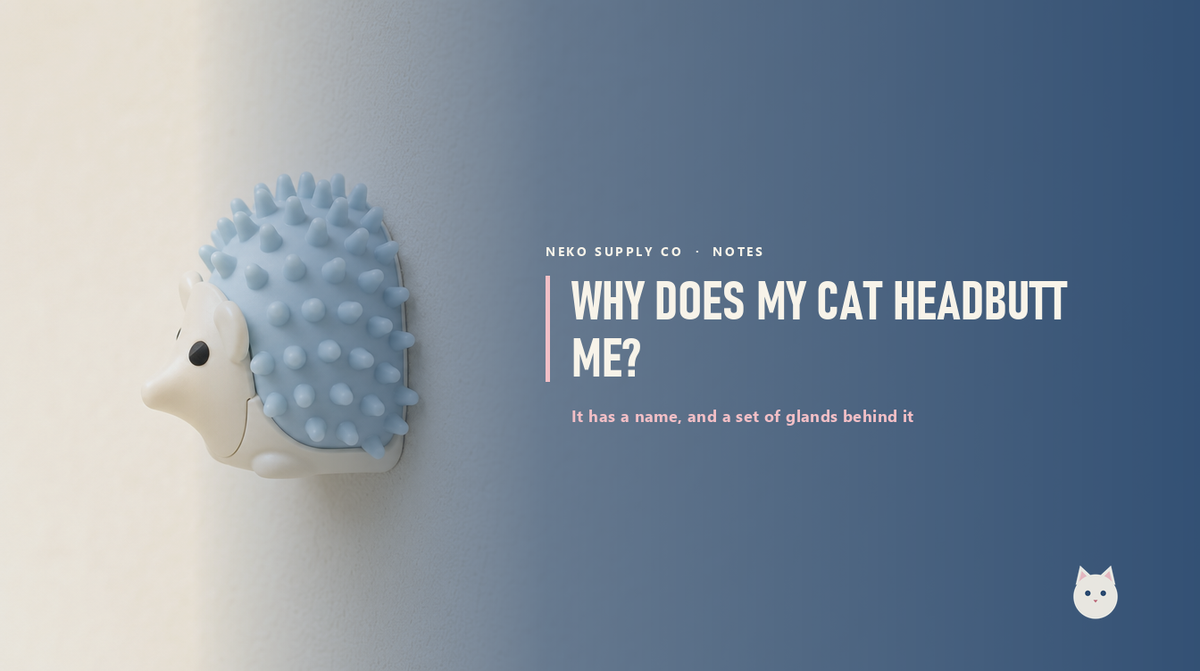
When a cat presses its forehead or cheek into you, it is depositing scent from glands on its face. The behaviour is called bunting, and it is your cat marking you as part of its safe, familiar territory. It is not quite the same as affection in the way people mean it, and it is arguably better.
Where the scent comes from
Cats have scent glands clustered around the face: on the cheeks, the chin, the corners of the mouth, and across the forehead in front of the ears. Rubbing those areas against something leaves a chemical signature only other cats can read. Your cat is not wiping its face on you. It is signing you.
Why you, and why the furniture
The same behaviour goes on the sofa corner, the door frame, the leg of a table, and the edge of a laptop you are trying to use. Corners and edges get the most attention because they are the boundaries of a space, and boundaries are where a scent mark does the most work. You get included because you move through that space and you are, from the cat's point of view, part of the furniture in the nicest possible sense.
Is headbutting the same as affection?
Not exactly, and the distinction is interesting rather than disappointing. Cats bunt on things they consider safe and theirs. A cat that head bumps you is telling you it is relaxed enough near you to spend effort on scent-marking, which is a stronger signal than a lot of behaviours people read as love. Cats in the same social group also bunt each other and end up sharing a group scent, so being included in that is genuinely meaningful.
When headbutting is worth a second look
Ordinary bunting is calm, brief, and clearly voluntary. Pressing the head against a wall or a hard surface and holding it there is a completely different behaviour, sometimes called head pressing, and it is a recognised sign of neurological trouble. If your cat is standing with its head against a wall for long stretches, that is a vet visit rather than a cuddle. Sudden obsessive rubbing at one spot on the face is also worth mentioning to a vet, since it can point to irritation or dental pain.
Can you give a cat something better to rub on?
Yes, and cats who bunt heavily often appreciate it. A fixed object at cheek height that they can rub against on their own schedule scratches the same itch as the door frame, without the door frame slowly acquiring a greasy patch. Placement is the whole trick: put it somewhere your cat already walks and already rubs, at about shoulder height, and give it a week before deciding it has failed.
Our version
The Nadenade Arch is a small soft hedgehog that fixes into a wall or table corner with soft rubber spikes for the cheeks and chin. なでなで nadenade means petting, which is roughly what your cat is doing to itself against it at four in the morning. We have written more on whether self-groomers actually work and where to put one.